Expert Panel Final Report on 28 April 2025 Blackout in Spain and Portugal
Expert Panel Final Report on 28 April 2025 Blackout in Spain and Portugal
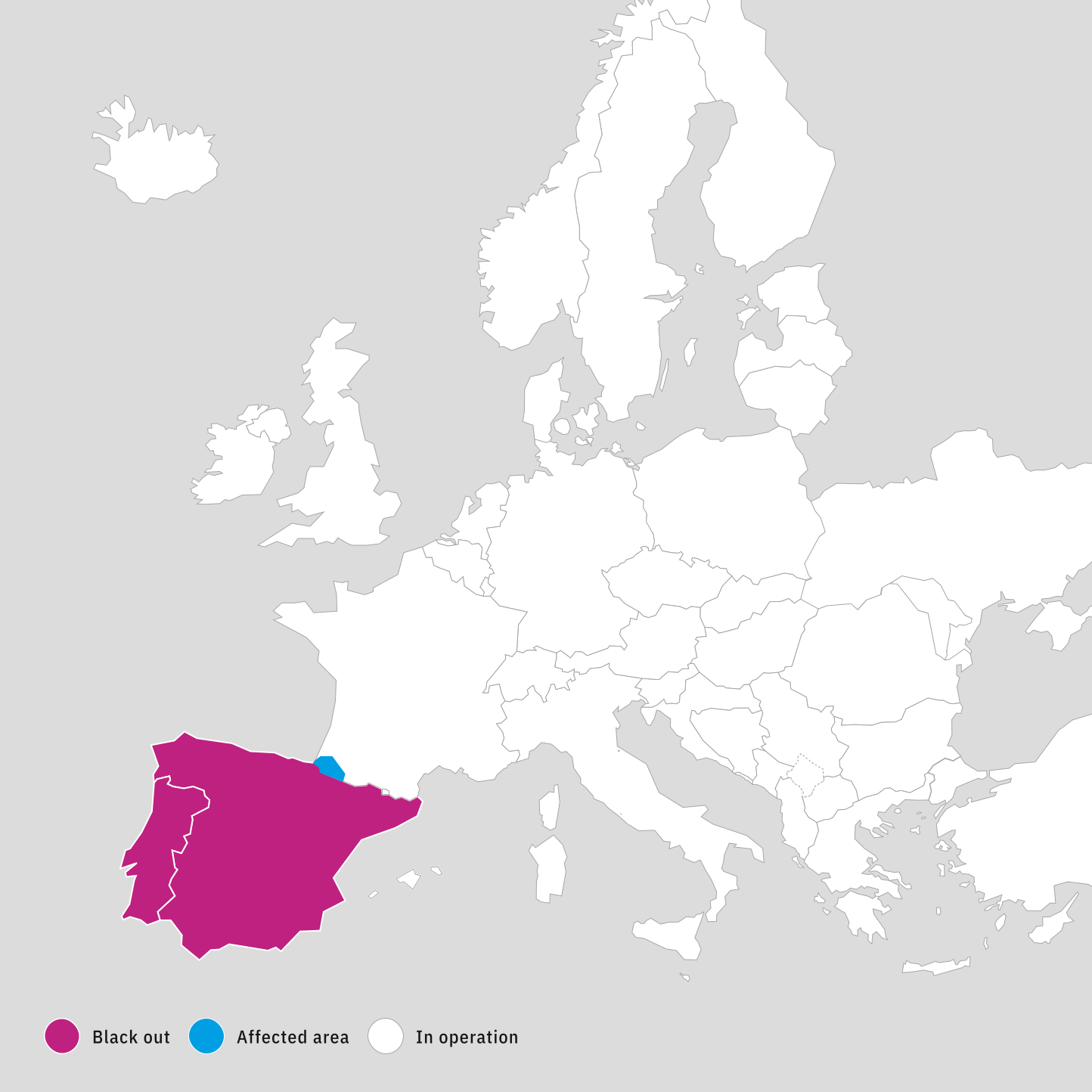
On Monday, 28 April 2025, a significant incident occurred on the Iberian Peninsula, leading to a total blackout in Spain and Portugal and short‑duration disturbances in a small area of Southwest France. According to the Incident Classification Scale (ICS) Methodology, the incident is classified as a scale 3 blackout.
In line with the ICS Methodology (developed in accordance with Regulation (EU) 2019/943), the scale 3 classification meets the RCC investigation threshold. Consequently, an RCC investigation subgroup was established under the Regional Coordination Centre Post‑Operation and Post‑Disturbances Analysis and Reporting (RIAR) Methodology, in accordance with Article 37(1)(i) of Regulation (EU) 2019/943.
The conclusions of this RCC investigation are incorporated into the Final Report that has now been published. This report describes the sequence of events and identifies the technical drivers behind the blackout, including voltage and reactive‑power control challenges, oscillations, and cascading generator disconnections. The report also provides recommendations to strengthen operational practices and cross‑border coordination to prevent similar incidents.
Regional Coordination Centres (RCCs), in close cooperation with Nordic and Continental Transmission System Operators (TSOs), announce the successful go-live of day-ahead and intraday capacity calculation for Hansa Phase 2a on 17 March 2026. This covers the implementation of the minimum coordinated capacity calculation (CCC) function and the delivery of cross-zonal capacity (CZC).
This milestone marks a significant step forward in strengthening coordinated capacity calculation within the Capacity Calculation Region (CCR) Hansa. The implementation of Phase 2a further harmonises the assessment of available transmission capacity across five borders: DK1-NL (Cobra Cable), DK1-DE/LU, NO2-NL (NorNed), NO2-DE/LU (NordLink), and SE4-PL (SwePol Link).
This supports more efficient grid utilisation and secure system operation across Europe. By applying aligned and transparent methodologies, the initiative enhances fair and consistent access to the European electricity market. Through CCC, parties within CCR Hansa determine the cross-border transmission capacity that can be safely and efficiently offered to the market for both the day-ahead and intraday timeframes.
Extensive testing conducted between September 2025 and March 2026 confirmed the full technical and operational readiness of Phase 2a. The milestone reflects strengthened collaboration between the Nordic and Continental European electricity market regions: “CCR Hansa is committed to fulfilling our common tasks and obligations to bring the two larger regions in the European market closer together.” – Anders Moe from Statnett and Paolo D’Urso from TenneT Netherlands, Chairs of the Hansa Regional Steering Committee.
The go-live is the successful result of joint efforts between the Nordic TSOs — Energinet, Svenska Kraftnät, and Statnett — and the Continental European TSOs — Polskie Sieci Elektroenergetyczne, 50Hertz, TenneT Germany, TenneT Netherlands, and Baltic Cable — carried out in close collaboration with RCCs Nordic RCC and TSCNET.
CCR Hansa is one of the designated regional coordination areas under the European Union’s electricity market framework. Coordinated capacity calculation is mandated under the Capacity Allocation and Congestion Management Regulation (CACM) (Commission Regulation (EU) 2015/1222), which sets harmonised rules for capacity allocation and congestion management across Europe’s interconnected power systems.
Coreso
and TSCNET monitoring report Central Europe SOR – Regulation (EU)
2019/943
Art. 46
(Year 2024)
Coreso and TSCNET have been coordinating cross-border grid planning in Central Europe for over a decade – today as formally established Regional Coordination Centres (RCCs).
Coreso
and TSCNET monitoring report Central Europe SOR – Regulation (EU)
2019/943
Art. 46
Recommendation to the TSO 2025 – Maximum Capacity Entry
Maximum Entry Capacity in accordance with Article 26(7) of Regulation (EU) 2019/943 of the European Parliament and of the Council of 5 June 2019 on the internal market for electricity.
Grid Incident in South-East Europe on 21 June 2024 ICS Investigation Expert Panel Final Report
On Friday, 21 June 2024, a significant incident occurred in South-East Europe. This led to a major disruption in the power system of Continental Europe (CE) that resulted in a blackout in Albania (OST), Bosnia and Herzegovina (NOSBiH), Montenegro (CGES), and Croatia (HOPS).
According to the Incident Classification Scale (ICS) Methodology (developed in accordance with Regulation (EU) 2019/943), the incident was a scale 3 blackout and above the RCC investigation threshold. Thereby, an RCC investigation subgroup has been established according to the Regional Coordination Centre Post-Operation and Post-Disturbances Analysis and Reporting (RIAR) Methodology in accordance with Article 37 (1) (i) of the Regulation (EU) 2019/943.
The final report on the Balkan Black Out June 21st has now been published by RCCs and ENTSO-E. The report has been written by ENTSO-E, the ICS Expert Panel and the RCC investigation subgroup in close cooperation. The final report includes the sequence of events, the identified causes and recommendations to prevent future incidents.
On 1 December 2024, CorNet, the co-operation programme between Coreso & TSCNET, reached an important milestone: the CGM, the first operational task on the RCC Service Platform, went live!
The CGM, also known as the Common Grid Model, represents the European electricity network and was developed by merging TSO Individual Grid Models (IGMs) using the common European Merging Function (EMF). By enabling operational coordination, this go-live will contribute to ensuring the security of electricity supply on a European level.